
TREMS PROJECT: Upcycled textile waste as construction material in concrete applications
RMIT researchers have discovered a practical and sustainable way to create high-performance next generation on ground slabs, while preventing large quantity of textile wastes from going into landfill, enhancing the circular economy system of our nation.

Early-age cracking in large-scale on ground slabs is one of the most long-standing, notorious, and painful issues in civil engineering practices, which, if not carefully dealt with, will cause premature corrosion, not only worsening building aesthetics, but also damaging structural integrity and safety.
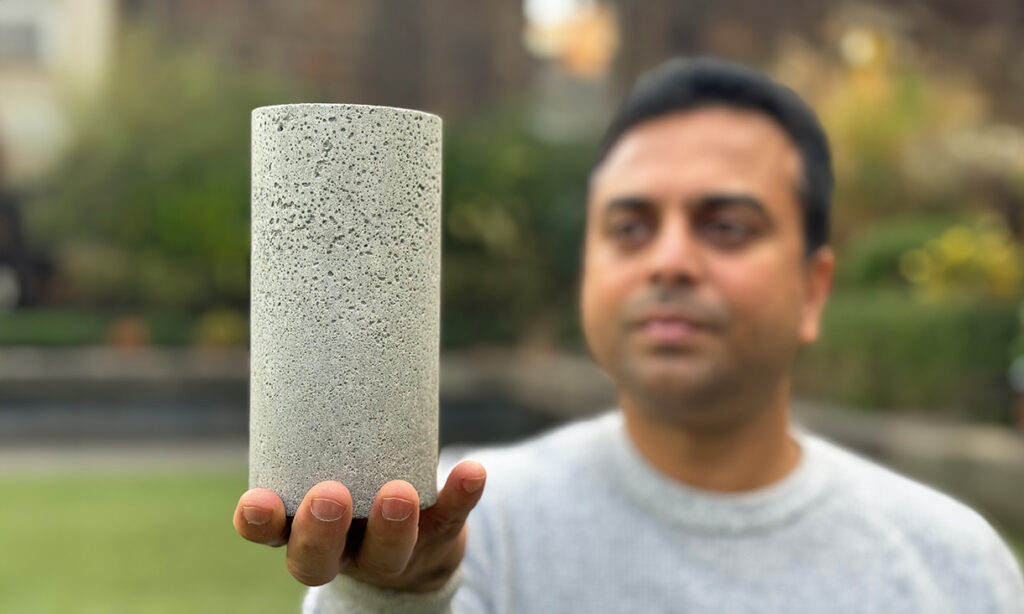
In RMIT University-led and Australian Research Council-funded projects: (ARC TREMS hub and ARC DECRA fellowship for Dr. Chamila Gunasekara), researchers have developed a prototype for transforming post consumed textile wastes from common households as well as garment factories into sustainable fibrous construction materials, with advanced performance, especially in mitigating early-age cracking.
According to reports, Australia is the second largest consumer of textiles per person in the world, after the US. The average Australian purchases 27kg of new clothing and textiles every year, and discards 23kg into landfill. This contributes to the 6000 kg of clothing and textile waste being discarded into landfill every 10 minutes. A large amount of textile waste is composed of synthetic materials that are non-degradable, which take hundreds of years to break down and continue to release carbon emissions during the process.
“On the top of the ability to mitigate early-age cracking, the novel inclusion of textile wastes in concrete will also prevent large quantity of textile wastes from going into landfill, contributing significantly to the transformation of reclaimed waste resources to engineered materials and solutions for a circular economy.
Reclaimed textile elevates the capability of concrete to combat shrinkage, hence mitigating early-age shrinkage.
“Moisture movement in large reinforced concrete ground slabs used in foundations of residential and industrial buildings and airport runways in Australia leads to cracking and consequent reduction in life expectancy. Often this can lead to demolition and reconstruction creating large volumes of waste,” said the research team.
Comprehensive laboratory research, conducted at RMIT, has demonstrated that the new concrete prototypes, incorporating various types of common reclaimed textile fibres, meet the standard requirements in terms of mechanical, structural and environmental performance. In particular, the team’s latest study discovered that reclaimed textile concrete is able to reduce over 30% of drying shrinkage under normal service conditions, greatly enhancing the capability in mitigating early-age cracking, compared to conventional concrete.
“These promising findings would build confidence in further solidifying the solution to reduce early-age cracking in reinforced concrete on ground slabs by incorporating upcycled waste textile fibre as additional reinforcement. The outcomes will create a value-added measure for textile waste, transcending the current situation, where 85% of which is disposed of in landfills,” said the research team.
Piloting in-situ field study and advanced computational techniques for securing wide-range applications.
“Laboratory work can only take you so far, as uncertainties and unexpected conditions encountered in real-life may very well surpass lab research. Thus, we are engaging with the industry partners, i.e., Textile Recyclers Australia, Godfrey Hirst Australia and Brimbank City Council, to facilitate full-scale in-situ field studies on ground slabs made of reclaimed textiles,” said the research team.
The major field trials and computational modelling are funded under the ARC Industrial Transformation Research Hub for Transformation of Reclaimed Waste Resources to Engineered Materials and Solutions for a Circular Economy (TREMS). The research team is collaborating with Luleå University of Technology, Sweden in computational modelling aspects.
We endeavor to leverage the power of computational mechanics and machine learning techniques to build a robust numerical framework for precisely capturing moisture transportation in the new-found material and predicting its long-term anti-cracking performance. With such a scientifically robust methodology, we expect to gradually build confidence in local councils and communities towards taking up this new measure in wide-range applications in the future.
Upto date Journal publications:
- Comprehensive review on sustainable fiber reinforced concrete incorporating recycled textile waste; Journal of Sustainable Cement-Based Materials
- A critical review on drying shrinkage mitigation strategies in cement-based materials; Journal of Building Engineering
- Microstructural characterisation of cementitious composite incorporating polymeric fibre: A comprehensive review; Construction and Building Materials Journal
- Utilization of upcycled fabric waste fibres in cementitious composite towards circular economy; Journal of Materials in Civil Engineering (ASCE)
- Upcycled blended fabric fibre reinforced cementitious composite: Mechanical and microstructural performance; Sustainable and Resilient Infrastructure Journal
- Upcycled PP and PTT carpet waste fibres in reinforcing cementitious composites; ACI Materials Journal